How New Technology is Helping Tattoo Artists
Tattooing has always been a craft defined by skill and precision. But the tools and systems surrounding that craft have changed faster in the past decade than in the previous century combined. Wireless machines, AI-powered design software, augmented reality previews, and studio management platforms have collectively shifted what’s possible—both for the artist and the client sitting in the chair. Artists who have embraced these changes are producing more complex work, running leaner businesses, and building international client bases. Those who haven’t are finding it harder to compete. This guide breaks down every major technological advancement reshaping the tattoo industry and explains what each one means in practice.
Tattoo Machine Evolution: From Coil to Wireless Rotary
For decades, coil machines were the industry standard. They work through electromagnetic coils that drive a needle bar in a hammering motion. The results are effective, but the setup demands significant mechanical knowledge. Artists needed to tune coil machines constantly—adjusting spring tension, contact gap, and voltage—making the machines as much an engineering challenge as an artistic tool.
Rotary and pen-style machines changed this dynamic entirely. Instead of an electromagnetic hammer, rotary machines use a rotating motor to drive the needle. The result is smoother, more consistent needle movement with far less vibration and noise. Pen machines—essentially rotary machines built into a grip format resembling a ballpoint pen—took this further by eliminating awkward hand positioning and reducing fatigue during long sessions.
The latest generation of wireless machines removes the cord entirely. Battery-powered units maintain consistent voltage output throughout a session without the drag and restriction of a power supply cable. Artists can move more naturally around the client, adjust position freely, and work with ergonomic efficiency that wasn’t available before.
Tattoo Machine Comparison
| Machine Type | Mechanism | Skill Level Required | Noise Level | Best For | Approx. Price Range |
|---|---|---|---|---|---|
| Coil Machine | Electromagnetic hammer | Advanced (requires tuning) | Loud | Traditional/bold lines | $100–$400 |
| Rotary Machine | Rotating motor | Beginner–Intermediate | Quiet | Realism, fine detail | $150–$600 |
| Pen Machine | Rotating motor (pen grip) | Beginner–Intermediate | Very quiet | All styles, long sessions | $150–$700 |
| Wireless Pen Machine | Battery-powered rotary | Beginner–Advanced | Very quiet | Precision, mobility | $250–$800 |
| Pneumatic Machine | Air pressure | Intermediate | Moderate | Sterile environments | $300–$900 |
Cartridges and Disposable Components: Hours Saved Weekly
Before cartridge needle systems became widely available, artists cleaned metal tubes after every session, ran autoclaves nightly, and in some cases soldered their own needle groupings. This was time-consuming, technically demanding, and introduced unnecessary infection risk.
Cartridge systems replaced all of that. A cartridge contains the needle configuration pre-assembled and sterile inside a disposable housing. When a session ends, the cartridge drops into a biohazard container. There is nothing to clean, solder, or sterilize. Grip tubes are now typically disposable as well, meaning the entire contact surface can be single-use.
The efficiency gain is significant. Artists who previously spent 30–45 minutes on post-session equipment processing now spend seconds. Over a full working week, that time difference becomes hours—hours that can go toward additional clients, practice, or rest.
Cartridge Needle Configurations and Use Cases
| Needle Type | Configuration | Primary Use |
|---|---|---|
| Round Liner (RL) | Needles in circular cluster | Line work, outlines |
| Round Shader (RS) | Circular, slightly spread | Soft shading, fill |
| Magnum (M1) | Two staggered rows | Color packing, shading |
| Curved Magnum (M1C) | Curved arc arrangement | Smooth gradients, realism |
| Flat (F) | Single horizontal row | Geometric work, hard fills |
| Bugpin | Very fine gauge needles | Ultra-fine detail, portraiture |
Digital Design Tools: iPad, Procreate, and AI
The introduction of the iPad and Procreate is frequently cited by working tattoo artists as the single most impactful technology shift in their creative process. Procreate provides a natural drawing experience with pressure-sensitive input, thousands of brush options, layered editing, and instant color adjustment—all on a device that fits in a backpack.
Before digital design tools, artists drew stencils by hand, traced references on lightboxes, or printed templates. Revisions meant starting over. Client changes at the last minute meant hours of rework. Procreate removes most of that friction. An artist can generate a custom design, show it to the client, adjust sizing or composition in real time, and produce a printable stencil in the same sitting.
AI-powered design tools are now extending this further. Platforms that generate reference imagery, suggest compositional variations, or produce initial rough drafts from text prompts allow artists to iterate faster—particularly useful when a client has a concept they struggle to describe. AI does not replace the artist’s hand or creative judgment, but it compresses the time between concept and finished stencil.

Augmented Reality and Tattoo Simulation Apps
One of the most client-facing technology advances is augmented reality (AR) tattoo preview applications. Apps like InkHunter overlay a proposed tattoo design onto the client’s skin using the smartphone camera, allowing real-time visualization before any needle touches skin. The client can rotate their arm, view the design in different lighting, and compare multiple placement options side by side.
This matters practically. A significant portion of tattoo regret stems from placement decisions that seemed right on paper but felt wrong once permanently applied. AR previews reduce this risk substantially. For artists, they also reduce the number of consultation rounds needed to align with a client’s vision—the client sees exactly what they’re committing to before the session begins.
Popular Tattoo Design and Preview Tools
| Tool | Platform | Primary Function | Price |
|---|---|---|---|
| Procreate | iPad (iOS) | Digital illustration, stencil creation | $12.99 (one-time) |
| InkHunter | iOS / Android | AR tattoo preview on skin | Free / Premium tiers |
| Adobe Fresco | iPad / Windows | Vector + raster illustration | Free / $9.99/month |
| Tattoo AI (various) | Web / Mobile | AI-generated design references | Free–$20/month |
| Canva / Adobe Express | Web / Mobile | Marketing materials, portfolio layouts | Free / $12.99/month |
Social Media as a Business Engine
Before social media, building a client list was a multi-year process. Artists depended on walk-in traffic, word of mouth, and the reputation of the shop they worked in. Becoming appointment-only—the marker of a successful independent artist—could take five to ten years of consistent work in a single location.
Instagram and TikTok restructured this entirely. A well-filmed time-lapse video of a completed piece can reach hundreds of thousands of people overnight. Artists with compelling work and basic content skills are building appointment backlogs within months rather than years. Geographic constraints have effectively dissolved—artists with large followings receive booking requests from across the country and internationally, creating the ability to travel and guest-spot with work already secured at the destination.
The practical implication is that a new artist with strong digital presence can achieve the income and client quality of a ten-year veteran far faster than was previously possible. The craft still requires mastery, but the distribution of that craft no longer depends on physical proximity or years of institutional reputation-building.
Studio Management Software and Online Booking
Administrative overhead is one of the least discussed but most time-consuming parts of running a tattoo practice. Scheduling, deposit collection, client communication, waiver management, and record-keeping historically required either a dedicated receptionist or constant artist attention between sessions.
Studio management platforms have automated most of this. Artists connect their availability calendar to an online booking system; clients book directly without back-and-forth messaging. Deposits are collected automatically at booking. Digital waiver systems present consent forms electronically and store signed copies permanently without physical paperwork. Appointment reminders sent automatically to clients have measurably reduced no-show rates—a direct revenue impact for independent artists.
Tattoo Studio Management Software Comparison
| Platform | Key Features | Best For | Starting Price |
|---|---|---|---|
| Vagaro | Booking, POS, waivers, marketing | Multi-artist studios | $30/month |
| Square Appointments | Booking, deposits, calendar sync | Solo artists | Free / $29/month |
| Tattoo Pro | Tattoo-specific booking, consent forms | Independent artists | ~$25/month |
| Booksy | Client discovery, booking, reviews | Artists building new clientele | $29.99/month |
| Acuity Scheduling | Custom intake forms, payments | Artists needing flexible workflows | $16/month |
Improved Ink Formulations and Safety Standards
Tattoo ink has historically operated outside pharmaceutical-grade oversight. The pigments used in most inks are industrial—the same compounds found in paints and textile dyes—and were never formulated with skin injection in mind. This is changing under regulatory pressure, particularly in Europe where restrictions on azo compounds, heavy metals, and other substances of concern have prompted widespread reformulation.
Modern ink manufacturers are producing formulas that undergo third-party testing for contaminants, provide full ingredient transparency, and in many cases offer vegan-certified options free from animal-derived binders. Some advanced formulations are specifically engineered with particle profiles optimized for laser removal—producing ink that holds color well during the life of the tattoo but responds more efficiently to laser fragmentation if removal is later desired.
Reformulated inks carry higher production costs, which is beginning to reflect in studio pricing. Artists investing in premium, tested inks are increasingly communicating this as a quality differentiator to clients—particularly those aware of health concerns associated with older ink formulations.
Advanced Laser Technology for Removal
Tattoo removal has historically been slow, painful, and inconsistent. Older Q-switched laser systems could break down darker inks reasonably well but struggled with colors—particularly greens, blues, and light yellows—and required large numbers of sessions with long recovery intervals between them.
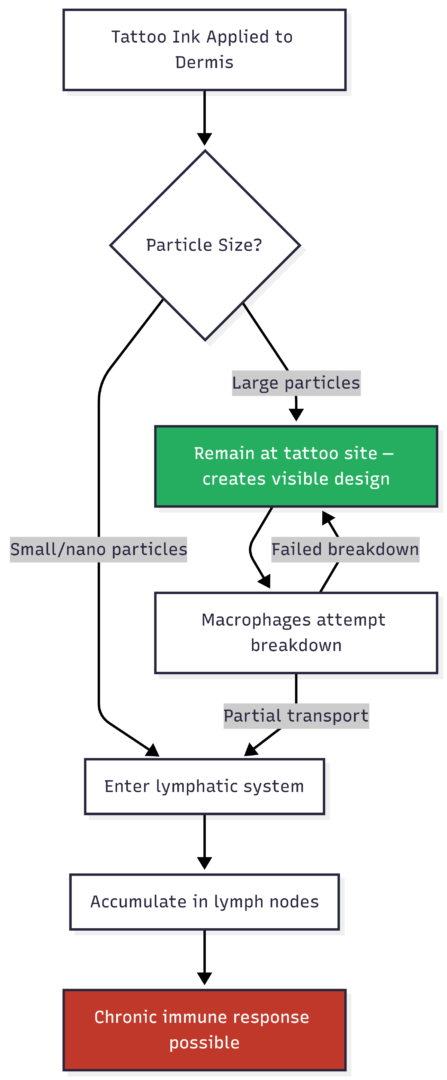
Picosecond laser technology changed the removal landscape. Instead of delivering nanosecond pulses, picosecond lasers fire in trillionths of a second, shattering ink particles into significantly smaller fragments that the body’s lymphatic system clears more efficiently. The practical result is fewer required sessions, more complete clearance of difficult colors, and reduced thermal damage to surrounding skin tissue.
Laser Tattoo Removal Technology Comparison
| Technology | Pulse Duration | Ink Colors Addressed | Sessions Required | Approx. Cost Per Session |
|---|---|---|---|---|
| Q-Switched Nd:YAG | Nanoseconds | Black, dark blue, red | 8–15+ | $100–$300 |
| Q-Switched Ruby | Nanoseconds | Black, green, blue | 6–12 | $150–$350 |
| Picosecond (PicoSure, etc.) | Picoseconds | All colors including difficult hues | 4–8 | $250–$600 |
| Picosecond + Fractional | Picoseconds | All colors + skin texture improvement | 4–6 | $300–$700 |
Sterilization, Air Quality, and Studio Safety Infrastructure
Modern autoclave units used in professional tattoo studios include digital monitoring systems that verify temperature, pressure, and cycle duration—producing a logged record of every sterilization run. This removes human error from the sterilization verification process and provides documentation for health inspections.
Hospital-grade HEPA air filtration systems have become common in higher-end studios. These remove airborne particulate matter—including ink aerosols generated during tattooing—creating cleaner air for both client and artist throughout sessions. For artists who spend forty or more hours per week in the studio environment, cumulative airborne exposure is a legitimate long-term health consideration that improved filtration addresses.
The combination of single-use components, verified sterilization cycles, and air filtration has elevated the safety baseline in professional tattooing to a level that approaches clinical standards in some respects.
Online Education and the New Path Into the Industry
The traditional tattoo apprenticeship required aspiring artists to commit to 50–60 unpaid hours per week for two to four years inside a shop. The model was the only viable entry point into the industry for most of its history, and it created significant barriers for anyone unable to work full-time without pay—parents, students, people in other careers, or those in regions without accessible shops willing to take apprentices.
Online learning platforms have opened a parallel path. Structured video curricula covering foundational drawing, skin theory, needle mechanics, shading technique, and stencil application are now accessible on-demand. Students practice on artificial skin at home, submit work for feedback, and progress at their own pace. This doesn’t replace hands-on experience with real clients, but it builds foundational competency that significantly compresses the time required to reach tattooing readiness.
Online supply ordering has supported this shift. Before e-commerce, aspiring artists ordered supplies by phone from catalogs distributed to established shops. Beginners learning outside a traditional shop had no reliable supply chain. Today, professional-grade equipment ships directly to individual artists anywhere.
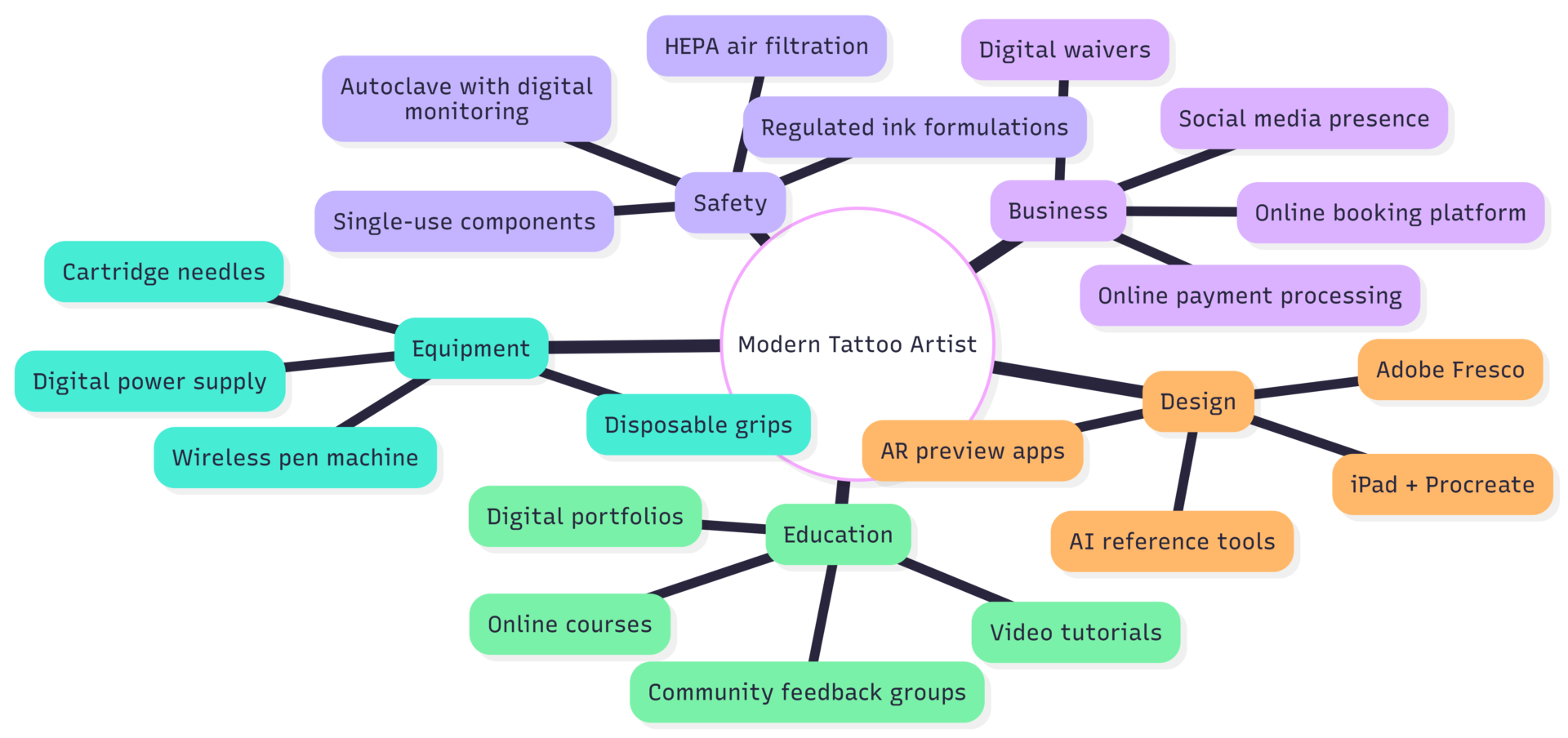
The Technology Stack of a Modern Tattoo Artist
What This Means for Artists and Clients
The cumulative effect of these technological shifts is a tattoo industry that is more accessible, more precise, and more professionally structured than it has ever been. New artists can build careers faster. Experienced artists can take on more complex work with better tools and fewer administrative burdens. Clients can make more informed decisions through previews, research more confidently through artist portfolios, and book seamlessly without friction.
Safety improvements—in equipment, ink formulation, sterilization, and air quality—mean that choosing a reputable modern studio carries meaningfully lower health risk than the industry standard of even fifteen years ago. Regulatory pressure on ink composition, though enforcement remains inconsistent, is pushing manufacturers toward greater transparency.
Technology has not changed what makes tattooing compelling—the skill, the artistry, the permanence of the work. But it has removed obstacles at almost every other point in the process, from the first concept sketch to the final healed result. For anyone working in or considering the craft, understanding these tools is no longer optional. It is the baseline of professional practice.
Please share this How New Technology is Helping Tattoo Artists with your friends and do a comment below about your feedback.
We will meet you on next article.
Until you can read, Does Tattoo Ink Cause Cancer?