AI-Generated Art: How Will it Affect Tattoo Artists?
AI-generated art is no longer a distant concept for the tattoo industry — it is already sitting in waiting rooms, being pulled up on clients’ phones, and discussed across studio counters every day. Its rise forces a genuine reckoning: is AI a threat, a tool, or simply the latest wave of technology that the industry will absorb, the same way it absorbed rotary machines, Instagram, and Procreate?
The honest answer is all three, depending on how an artist responds to it.
What AI art tools actually do
AI image generators — Midjourney, DALL-E, Adobe Firefly, and others — work by training on enormous datasets of existing images sourced from across the internet. When a user types a prompt like “Japanese dragon tattoo on a man’s shoulder,” the system synthesises a composite image drawn from millions of reference points. It does this in seconds.
Some tools go further, allowing users to draw a rough sketch that the AI then renders into a detailed image. Others accept mood keywords or the names of existing artists to narrow down a particular aesthetic. The output is always original in the sense that it is not a direct copy of any single source, but it is entirely derivative of every source it has ever processed.
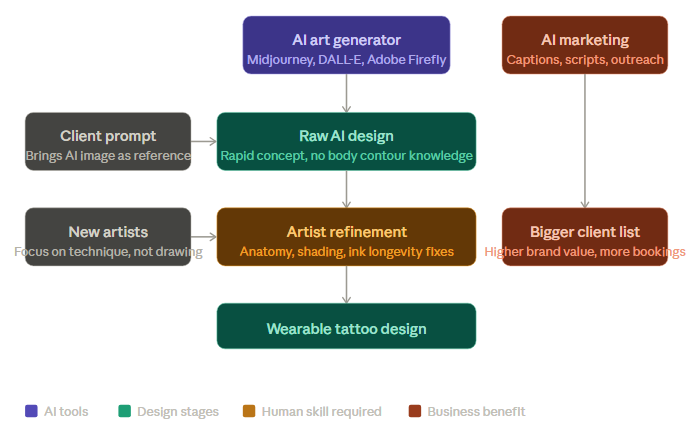
At present, AI-generated tattoo designs have a fundamental flaw that makes them unusable as final pieces: they have no concept of the human body. A great tattoo design is not just an image — it is an image built to flow with muscle curves, wrap around joints, and hold up as ink ages and spreads over decades. AI generators have no understanding of any of this. The designs they produce are frequently over-detailed, symmetry-dependent in ways that do not translate to curved skin, and filled with elements that will blur into an unreadable mess within a few years of being tattooed.
This means that in their current state, AI designs are raw material, not finished products. Every AI-generated image brought into a studio still requires significant work from the artist before it becomes tattooable.
The client problem
The most immediate friction AI has introduced is at the consultation stage. Clients now arrive with AI-generated reference images and often believe those images represent something that can be tattooed exactly as shown. They do not understand why the intricate crosshatching that looks stunning on a screen will not survive on skin, or why the design that appears perfectly symmetrical on a flat image will distort when wrapped around an arm.
This creates an educational burden for artists. Time that used to go toward designing now gets spent explaining the gap between what AI can generate and what can actually be tattooed. For artists who are already stretched thin between consultations, tattooing, and aftercare follow-ups, this friction is a real cost.
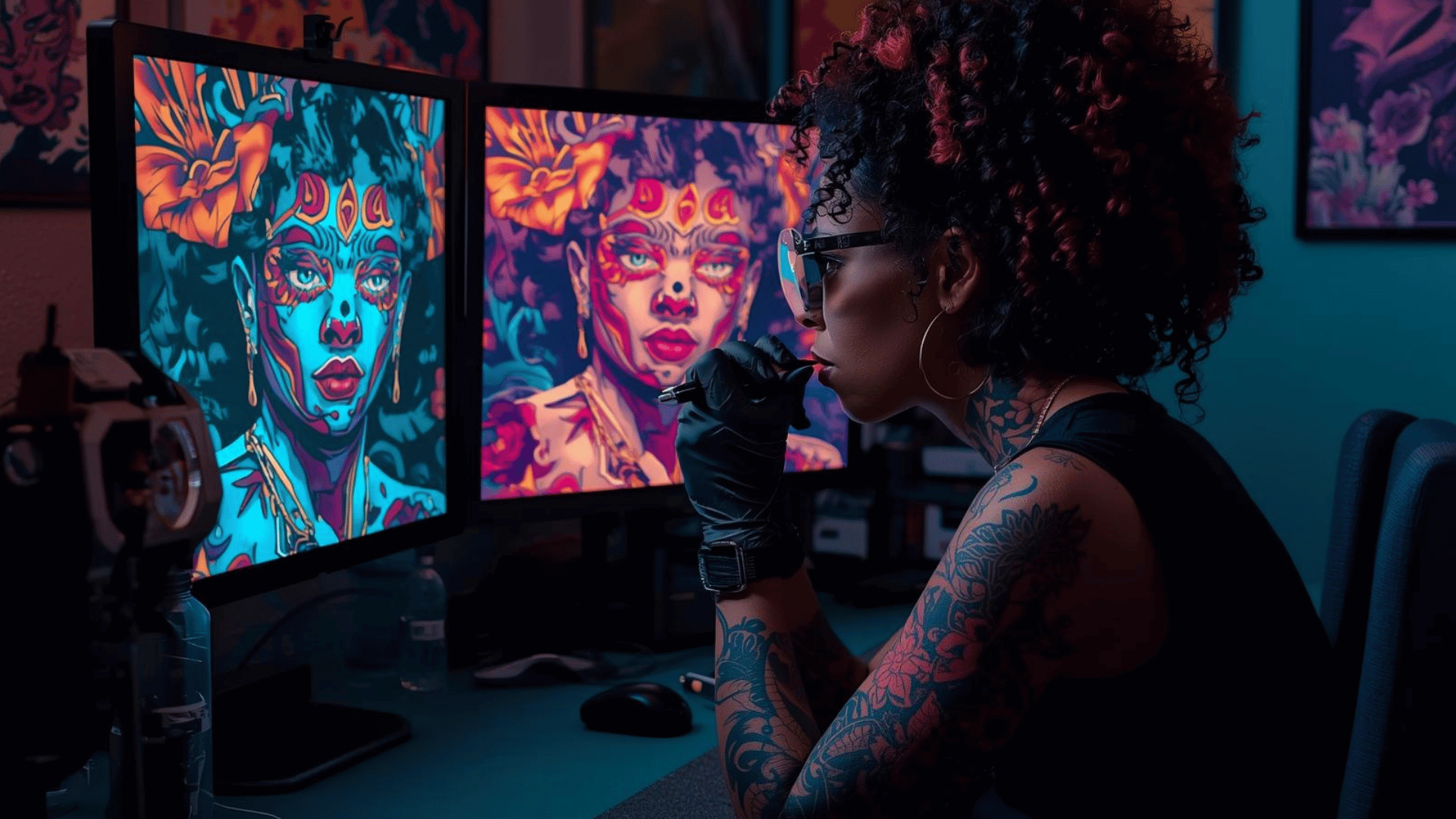
That said, AI references do carry a genuine upside for consultations. Clients who struggle to articulate what they want — who say things like “something dark but not too dark” or “kind of like nature but also geometric” — can now use AI tools to produce a visual starting point that gives the artist something concrete to respond to. Used this way, AI accelerates the consultation and reduces misunderstandings about style and direction.
Where AI genuinely helps: design speed and marketing
For artists who adopt it strategically, AI offers two significant advantages.
The first is design speed. A large custom tattoo can take six or more hours to draw from scratch. An AI generator can produce multiple directional concepts in under a minute. An artist can then select the most promising output and refine it — correcting body flow, adjusting line weights, simplifying over-detailed areas — rather than starting from a blank page. This does not replace the artist’s drawing skill, but it compresses the time required to reach a workable draft.
The second advantage is marketing. Most tattoo artists are skilled at their craft but less comfortable with content creation. Social media algorithms reward volume: TikTok recommends one to four posts per day, Instagram at least one. Producing that volume of quality content alongside a full tattooing schedule is genuinely difficult. AI writing tools can generate captions, email responses, hashtag strategies, and promotional copy quickly, allowing artists to maintain a consistent online presence without sacrificing studio hours.
Artists who combine AI-generated design speed with AI-assisted marketing are able to take more appointments, produce more portfolio content, and build a larger online following faster than artists working entirely by hand. This is not a marginal advantage — over time it compounds significantly.
| Area | AI-generated design | Human artist design |
|---|---|---|
| Speed | Seconds per concept | Hours per custom design |
| Body flow | Poor — no anatomical awareness | Strong — designs follow muscle contours |
| Longevity | Often over-detailed; fades poorly | Optimised for how ink ages |
| Originality | Unique outputs, but style-averaged | Distinct personal style and signature |
| Client education | Creates unrealistic expectations | Manages feasibility from the start |
| Cost to artist | Free–$30/month (subscription tools) | Years of practice investment |
| Best use | Inspiration, client consultations, marketing | Final design execution and tattooing |
The threat to established artists who resist
The tattoo industry has seen this dynamic before. When rotary machines replaced coil machines for many applications, artists who dismissed them as inferior were eventually surpassed by those who learned to use both. When Instagram emerged, artists who ignored it found their client lists shrinking as clients sought out artists they could discover online. When Procreate became a standard design tool, artists who refused to use tablets found themselves spending far more time on drawings than their digitally fluent peers.
AI is likely to follow the same pattern, but at a larger scale. The gap between an artist using AI tools and one ignoring them will not be subtle. An artist using AI for design drafts, social media content, and client inbox management is effectively gaining several hours back per week — hours that compound into a larger book of work, a stronger portfolio, and a higher hourly rate over time.
Artists who are highly skilled but technologically resistant face a version of the same choice that every previous generation of tattooers faced when new tools emerged: adapt early and gain an advantage, or adapt late and spend years catching up.
The impact on new artists and apprenticeships
The traditional gatekeeping mechanism for entering tattooing has always been the portfolio review. To secure an apprenticeship, an aspiring tattooist had to demonstrate a high level of drawing skill before ever touching a machine. This made sense when drawing and tattooing were inseparable disciplines, but AI is beginning to decouple them.
An aspiring artist who uses AI to generate designs, and focuses their energy entirely on developing the technical execution side — machine control, needle depth, shading technique, ink saturation — can progress faster than someone spending equal time on both drawing and technique. This lowers the entry barrier significantly.
This does not mean technical skill matters less. If anything, the execution side of tattooing becomes more important when the design side is partially automated — the differentiator between artists shifts from “who can draw the best concept” toward “who can transfer that concept most precisely and durably onto skin.” Artists who develop excellent technical execution while leveraging AI for design have a real advantage over those who can draw beautifully but tattoo with average technique.
The downstream effect on apprenticeships is likely to be a shift toward shorter, more structured programs focused on technical execution, and a reduction in the gatekeeping around drawing portfolios. As more governing bodies pay attention to the growing industry, more formalised training standards are also likely, which should reduce some of the unpaid labour abuse that informal apprenticeships have historically enabled.
What AI cannot replace
Despite everything it can do, AI has firm limits in the context of tattooing.
It cannot understand the body the way an experienced tattooist does. It cannot assess skin tone, texture, or scarring when planning a design. It cannot make the judgment call that a particular placement will not age well, or that a client’s pain tolerance means a certain session length is unrealistic. It cannot build the client relationship that turns a first appointment into a loyal customer who refers three friends.
Most importantly, AI cannot inject ink. No matter how sophisticated the design pipeline becomes, the physical act of tattooing still requires a skilled human hand. This is why the comment that circulated on Reddit when this topic was being discussed — “tattoo artists are among the least affected by AI art; at least people actually need your skill with a needle” — contains real truth, even if it overstates how untouched the industry will remain.
The artists most at risk are not those doing the tattooing, but those whose value proposition was primarily in design creation rather than technical execution. Custom flash sheet artists, for example, may find the market for pre-drawn designs more competitive as AI tools make it easy for anyone to produce volume. But artists who tattoo well, build genuine client relationships, and use AI as a workflow accelerator rather than a crutch will likely find their position strengthened, not threatened.
Practical steps for artists navigating the shift
For working tattoo artists, the most useful orientation toward AI is neither fear nor uncritical enthusiasm. It is practical experimentation. Testing one AI design tool for client consultations, spending a month using AI for social media captions, and paying attention to where time is currently being lost in a weekly workflow — these are low-risk ways to identify where AI genuinely helps versus where it creates more work.
For artists still building their careers, the calculation is different. The ability to use AI fluently is increasingly becoming a standard professional skill rather than an advanced one. Getting comfortable with it now, while it is still a differentiator, is far easier than being forced to adopt it reactively in a few years when it is simply expected.
The tattoo industry has always evolved alongside its tools. AI is the latest tool. Whether it becomes an advantage or an anxiety depends almost entirely on how individual artists choose to approach it.
Please share this AI-Generated Art: How Will it Affect Tattoo Artists? with your friends and do a comment below about your feedback.
We will meet you on next article.
Until you can read, Lucky Diamond Rich: Most inked man on Earth