Michelle Williams and the Art of the Butterfly Tattoo
The butterfly tattoo has never truly disappeared. It has lived in lower backs, shoulders, ankles, and wrists for decades — quietly enduring through every tattoo trend that came and went. But pop culture has a way of reigniting what was already glowing, and right now, the butterfly tattoo is having its moment again. And it has a familiar name attached to it.
The Masked Singer, a Butterfly, and a Famous Clue
The Masked Singer is a reality competition show built entirely on suspense. Celebrities perform in elaborate, full-body costumes while a panel of judges and the viewing audience try to guess who’s hiding underneath. The clues are layered — personal histories, career milestones, obscure details that only true fans would catch.
One contestant, performing under the name “Butterfly,” dropped a clue that set social media ablaze: a butterfly tattoo. Paired with references to being at the peak of fame within a group, then struggling when going solo, the clues pointed unmistakably toward one person — Michelle Williams, former member of Destiny’s Child.
Williams was one of the defining voices of one of the most successful girl groups in music history. She stepped out of the spotlight for years, and her absence made the speculation around Butterfly feel all the more charged. Whether or not the reveal confirmed it, the conversation it sparked was undeniable — and so was the renewed fascination with the butterfly tattoo itself.
Why Butterfly Tattoos? The Symbolism Behind the Design
Before diving into the style evolution, it’s worth understanding why butterfly tattoos have resonated so deeply across generations and cultures.
The butterfly is one of the most universally understood symbols in the world. Its meaning shifts slightly depending on cultural context, but the core themes remain consistent:
- Transformation and rebirth — The metamorphosis from caterpillar to butterfly is a powerful metaphor for personal growth, recovery, or reinvention.
- Freedom — The image of something taking flight carries obvious emotional weight.
- Femininity and beauty — Without being prescriptive, the butterfly has long been associated with grace and delicacy.
- Impermanence — In Japanese and East Asian traditions, butterflies represent the fleeting nature of life, making them both beautiful and poignant.
- The soul — In ancient Greek mythology, the butterfly (psyche) represented the soul itself.
These layered meanings make the butterfly one of the most versatile tattoo subjects. It can mean something deeply personal or simply be admired for its visual elegance. That duality is rare, and it’s a big reason the design never truly goes out of style.
The Lower Back Era: History of the “Tramp Stamp”
To understand where butterfly tattoos are today, you have to understand where they came from — and that means addressing the cultural baggage head-on.
In the late 1990s and early 2000s, tattoos were becoming increasingly mainstream among women. The lower back emerged as a particularly popular placement for a very practical reason: it was easily concealable. A woman could get inked, feel expressive and free, and still wear professional clothing without anyone knowing. But when crop tops, low-rise jeans, and bare midriff fashion took over, the tattoo was right there to show off.
The butterfly was a natural fit for this placement. It was compact, symmetrical, colorful, and expressive — everything you’d want in a tattoo designed for that specific canvas.
Unfortunately, rather than celebrating women’s autonomy over their own bodies, the cultural response was to coin a dismissive slur: the “tramp stamp.” It was a deliberate attempt to degrade women who chose visible self-expression. The term stuck, and for a while it cast a shadow over what was genuinely a creative and personal form of body art.
But here’s the thing — the butterfly tattoo outlasted the insult. It evolved.
The Evolution of Butterfly Tattoo Styles
Today’s butterfly tattoos bear little resemblance to the simple, symmetrical designs of the 90s. Artists have pushed the concept into extraordinary new territory, and the style options available now reflect the full breadth of modern tattooing.
Popular Butterfly Tattoo Styles
| Style | Description | Best Placement | Typical Detail Level |
|---|---|---|---|
| Traditional/Old School | Bold outlines, limited color palette, classic Americana feel | Upper arm, calf | Medium |
| Realism | Photorealistic rendering of actual butterfly species | Back, thigh, chest | Very High |
| Watercolor | Loose, flowing color washes with minimal linework | Shoulder blade, ribs | Medium–High |
| Geometric | Angular, structured interpretations using shapes | Forearm, sternum | High |
| Neo-Traditional | Detailed linework with rich, expanded color palette | Upper arm, thigh | High |
| Fine Line | Delicate, minimal lines for a subtle, elegant result | Wrist, ankle, collarbone | High |
| Blackwork | Bold black ink only, often with negative space | Upper arm, back | Medium–High |
| Japanese (Irezumi) | Traditional Japanese aesthetic integrated with butterfly motifs | Full back, sleeve | Very High |
The diversity in this table reflects how far the butterfly has traveled as a tattoo subject. It’s no longer just a symbol — it’s a canvas for entire artistic movements.
Best Placements for Butterfly Tattoos in the Modern Era
Placement transforms a tattoo. The same design can feel intimate on a wrist, bold on a chest, or dramatic on a full back. Here’s how modern tattoo enthusiasts are approaching butterfly placement:
Upper Back Moving from the lower back to the upper back dramatically expands the available canvas. Artists can work larger, add more detail, and incorporate surrounding elements like florals, geometric frames, or additional insects. The design stays easily concealable with most clothing but makes a strong statement in backless or open-back styles.
Shoulder Blade One of the most naturally fitting placements for a butterfly. The shape of the shoulder blade mirrors the way wings extend from a body, creating an organic visual harmony. Both single-wing and full-spread designs work beautifully here.
Sternum / Chest Butterfly tattoos centered on the sternum have become one of the most popular placements in contemporary tattooing. The wings spread outward across the chest, framing the collarbone. It’s bold, personal, and visually stunning.
Arm and Sleeve Butterflies integrate naturally into sleeve tattoos. A single butterfly can anchor a sleeve, or multiple butterflies can be woven through a larger compositional design. Because of their natural elegance, they rarely feel out of place alongside other elements.
Neck Neck tattoos carry a certain commitment and boldness. A butterfly on the nape of the neck or along the side of the neck makes an unmistakable statement. It’s visible, expressive, and increasingly popular as tattoo culture becomes more mainstream.
Ankle and Wrist For those wanting something smaller and more subtle, the ankle and wrist remain beloved placements. A fine-line butterfly on the inside of the wrist is among the most minimalist and refined options available.
Butterfly Tattoo Size and Investment: What to Expect
One of the practical advantages of butterfly tattoos is their flexibility in scale. A tiny fine-line butterfly on the wrist can be completed in under an hour, while a fully detailed, photorealistic butterfly spanning the upper back can be a multi-session project.
Rough Cost Guide (USD)
| Size | Estimated Time | Estimated Cost Range |
|---|---|---|
| Small (1–2 inches) | 30–60 min | $80–$200 |
| Medium (3–5 inches) | 1.5–3 hours | $200–$500 |
| Large (5–8 inches) | 3–6 hours | $500–$1,000+ |
| Full Back / Sleeve Piece | Multiple sessions | $1,500–$5,000+ |
Prices vary significantly based on artist experience, geographic location, studio rates, and design complexity. Always research your artist thoroughly and expect to pay premium rates for exceptional work.
How to Choose the Right Butterfly Tattoo
With so many options, the decision can feel overwhelming. A few guiding principles help narrow it down:
Start with meaning. Do you want the butterfly to represent something specific — a person, a transformation, a period of your life? If so, let that story inform the design. If you simply love the aesthetic, that’s equally valid.
Consider longevity. Fine line tattoos are beautiful but can fade and blur over time, especially in high-friction areas. Bold traditional or neo-traditional work tends to age better. Discuss this honestly with your artist.
Choose your artist based on style. Not every tattoo artist excels in every style. If you want hyperrealistic wings, find someone with a strong realism portfolio. If you want watercolor, seek out an artist who specializes in it. The match between your vision and the artist’s strength is everything.
Don’t rush placement. Where the tattoo lives on your body matters for both aesthetics and practicality. Think about your lifestyle, your wardrobe, and how visible you want it to be.
The Mermaid Chart: Journey of the Butterfly Tattoo
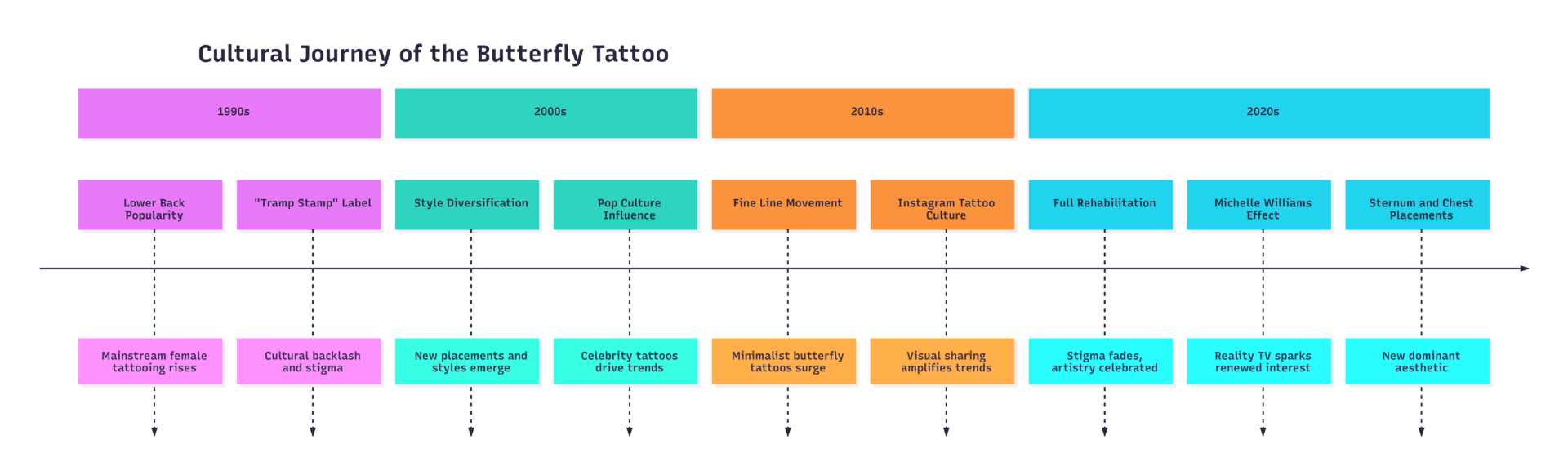
Why the Butterfly Tattoo Will Never Go Out of Style
Trends come and trends go. The skull had its moment. The infinity symbol had its moment. The dreamcatcher had its moment. The butterfly has had multiple moments spanning multiple decades — and each time it returns, it returns evolved.
The core reason is symbolism. The butterfly carries meaning that is genuinely universal. It speaks to experiences that nearly every human being has — change, loss, growth, hope, freedom. That emotional range means it never becomes irrelevant.
The second reason is visual versatility. A butterfly can be rendered in virtually any artistic style and still be recognizable. It works at any scale. It complements other design elements. It suits every skin tone and body type. Very few tattoo subjects can claim the same flexibility.
And finally, the butterfly benefits from cultural reinvention. Whether it’s Michelle Williams’ Masked Singer appearance, a viral TikTok tattoo trend, or a fashion week runway look, the butterfly keeps finding new champions. Each reinvention introduces the design to a new generation while reminding older ones why they loved it in the first place.
Final Thoughts
Michelle Williams may or may not be the Butterfly on The Masked Singer. But the conversation she sparked is real, and so is the renewed enthusiasm around one of tattooing’s most enduring designs.
The butterfly tattoo has survived stigma, evolved through countless artistic movements, and emerged as something genuinely timeless. Whether you want a delicate fine-line piece on your wrist or a full photorealistic wingspan across your upper back, the butterfly offers a design language that is personal, powerful, and perpetually relevant.
If you’ve been thinking about getting one — now might be exactly the right time.
Please share this Michelle Williams and the Art of the Butterfly Tattoo with your friends and do a comment below about your feedback.
We will meet you on next article.
Until you can read, The Aaron Carter Face Tattoo: All You Need to Know