Does tattoo ink give you cancer?
Tattooing is one of the oldest forms of human expression, and today it’s more popular than ever. Estimates suggest four in ten women and three in ten men will have at least one tattoo by their mid-twenties. Yet most people who sit in a tattoo chair spend far more time choosing their design than they do thinking about what happens to the ink once it’s under their skin. That oversight may be worth correcting.
The short answer to whether tattoo ink causes cancer is: not conclusively, but the research is raising red flags that deserve serious attention. There is currently no documented case of cancer directly and exclusively caused by a tattoo. However, multiple peer-reviewed studies have found statistically significant associations between tattoos and certain cancers—particularly lymphoma and melanoma—and the mechanisms behind those associations are becoming clearer.
What’s Actually in Tattoo Ink?
Before examining cancer risk, it helps to understand what tattoo ink contains. Ink is not a single regulated substance. It varies widely by manufacturer, color, and country of origin, and historically has been subject to minimal oversight.
A 2016 report from Australia’s National Industrial Chemical Notification and Assessment Scheme (NICNAS) analyzed 49 tattoo inks and found significant mismatches between labeled ingredients and actual contents. Among the concerning findings:
- Polycyclic Aromatic Hydrocarbons (PAHs) — known carcinogens classified by the WHO’s International Agency for Research on Cancer — appeared in 20% of all samples and in 83% of black inks tested.
- Heavy metals including barium, cobalt, chromium, copper, nickel, and mercury were identified across multiple colors.
- Azo pigments used in colored inks can break down into carcinogenic aromatic amines when exposed to UV light.
| Ink Color | Common Hazardous Component | Potential Risk |
|---|---|---|
| Black | Polycyclic Aromatic Hydrocarbons (PAHs) | Known carcinogens; classified by IARC |
| Red | Mercury (historically); now often cadmium | Allergic reactions; systemic toxicity |
| Blue/Green | Cobalt, copper | Heavy metal accumulation |
| White | Barium | Possible toxicity in lymphatic tissue |
| All colors | Azo pigments | Break down to aromatic amines under UV |
These substances occur in small concentrations, but the problem is that they don’t simply remain at the injection site. They move.
How Ink Travels Through Your Body
Tattoo ink is injected into the dermis—the deeper layer of skin beneath the surface epidermis. The body immediately recognizes ink particles as foreign substances. Immune cells called macrophages engulf the particles in an attempt to neutralize them. Many particles are too large to be fully broken down, so instead the macrophages transport them into the lymphatic system.
The lymph nodes—small glands distributed throughout the body that filter harmful substances and coordinate immune responses—then become repositories for accumulated ink.

This migration is well-documented. The key question researchers are now working to answer is whether that accumulation, and the chronic immune response it triggers, contributes to cancer development.
The Lymphoma Connection
The most significant research on this question comes from the Danish Twin Tattoo Cohort, a dataset of more than 5,900 Danish twins studied by researchers at the University of Southern Denmark and the University of Helsinki.
By comparing twins—individuals who share the same genetics and many environmental factors—researchers could isolate the effect of tattoos more precisely than general population studies allow. Their findings showed tattooed individuals were more frequently diagnosed with both skin cancers and lymphomas than their non-tattooed twins.
The results were especially striking for large tattoos, defined as larger than the palm of a hand:
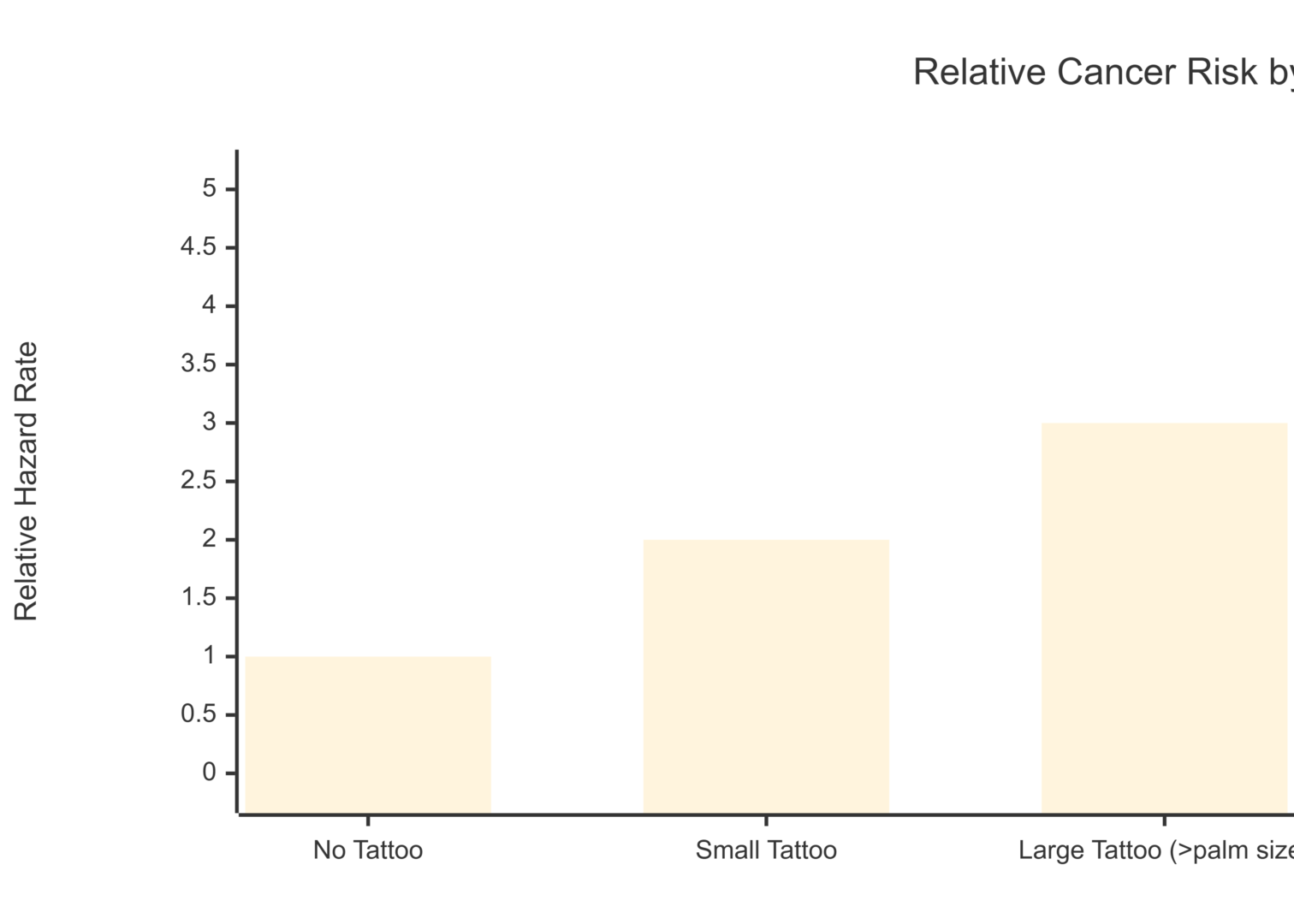
For lymphoma specifically, individuals with large tattoos had a hazard rate nearly four times higher than those without tattoos, after accounting for age, tattoo timing, and follow-up duration.
Henrik Frederiksen, consultant in haematology at Odense University Hospital and clinical professor at SDU, explained the suspected mechanism: the immune system perceives ink particles as persistent foreign invaders. The constant effort to neutralize them may keep the lymph nodes in a state of chronic inflammation—a known precursor to abnormal cell growth.
These Danish findings are consistent with an independent Swedish study published in the European Journal of Epidemiology. That study reviewed 2,880 melanoma cases and found that tattooed individuals had a 29% higher risk of developing melanoma than those without tattoos, even after controlling for sun exposure, tanning beds, skin type, and other standard risk factors. Among those tattooed for 10 to 15 years, the elevated melanoma risk reached 67%.
Understanding Relative Risk vs. Absolute Risk
The statistics above sound alarming, but context matters significantly. The studies report relative risk—how much more likely a tattooed person is to develop cancer compared to a non-tattooed person. Absolute risk tells a different story.
| Scenario | Baseline Cancer Risk (Hypothetical) | Risk After Large Tattoo (×3.91) |
|---|---|---|
| Skin cancer in general population | ~1% lifetime risk | ~3.9% lifetime risk |
| Lymphoma in general population | ~2% lifetime risk | ~7.8% lifetime risk |
| Melanoma in general population | ~2.5% lifetime risk | ~3.25% lifetime risk (×1.29) |
Put simply: if your baseline risk is 1 in 100, a roughly 4x relative increase brings your risk to approximately 4 in 100. That remains a minority outcome, but it is a meaningful increase that researchers argue warrants serious investigation.
The Melanoma Question: A Surprising Contradiction
Not all recent research points in the same direction. A study published in 2025 found that people with three or more large tattoos had a 74% lower risk of melanoma compared to the general population. This appears directly at odds with the Swedish research.
The contradiction likely reflects a methodological difference: the 2025 study may not have fully controlled for confounding variables like skin type, sun behavior, or selective tattoo placement away from sun-exposed areas. Researchers on both sides acknowledge that the relationship between tattoos and melanoma is far from settled.
What is consistent across studies is this: tattoos over or near moles complicate clinical detection. Tattoo pigment can mask color changes in the skin, obscure irregular borders, and make it genuinely difficult for a dermatologist to spot early-stage melanoma. This is a known diagnostic challenge regardless of which direction the biological risk points.
Tattoo Removal: Does It Make Things Worse?
One dimension that receives less public attention is the risk associated with laser tattoo removal. Laser removal works by breaking down ink particles into smaller fragments so the body can carry them away. This process significantly increases the quantity of particles entering the lymphatic system in a concentrated period.
Available evidence suggests that lymphoma risk increases more sharply following laser removal than with the original tattoo. Smaller post-laser particles may also be more capable of crossing cell membranes—raising the possibility of direct cellular damage that isn’t present with intact, larger ink particles.
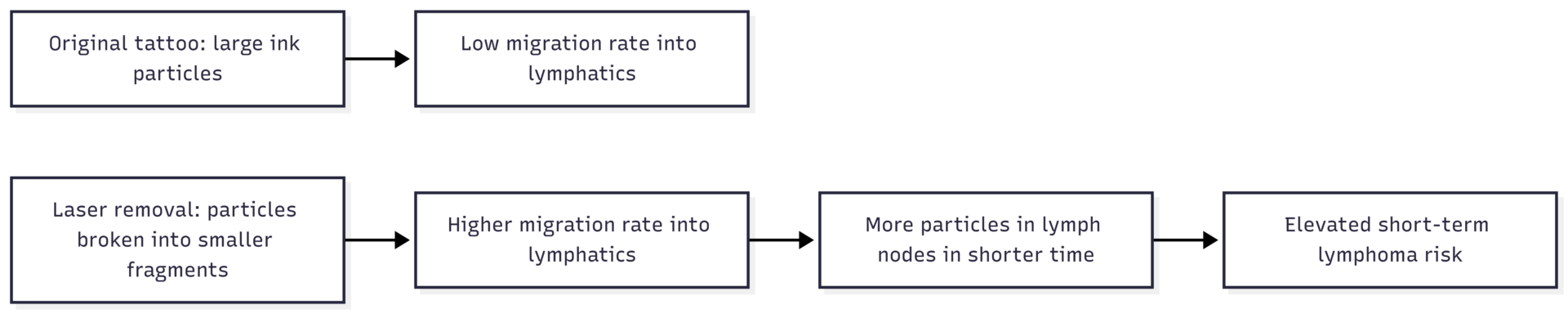
This is an area where more research is critically needed. The 2022 EU regulations that restrict thousands of chemicals in tattoo ink do not currently address the specific risks associated with removal processes.
What the Research Can and Cannot Tell Us
The studies discussed here share an important limitation: cancer takes years or decades to develop. A tattoo received at age 20 may not manifest any health consequence until age 40 or 50. The Danish twin study design goes further than most in controlling for genetic and environmental similarities, but it cannot fully account for lifestyle divergences between siblings—smoking, alcohol use, sun exposure—that independently raise cancer risk.
There is also a behavioral correlation worth noting. Research has documented that tattooed individuals, particularly young people, are more likely to engage in risk-elevating behaviors including tobacco use, alcohol consumption, and increased UV exposure. Whether the tattoo or the associated lifestyle is driving elevated cancer rates in some studies remains an open question.
The researchers behind the Danish study explicitly acknowledge this challenge: exposure in youth may take decades to produce measurable disease, making direct causal attribution extremely difficult.
What we can say with confidence:
- Tattoo inks contain documented carcinogens.
- Those carcinogens reach the lymph nodes.
- Multiple independent studies have found elevated cancer rates in tattooed populations.
- The largest tattoos carry the highest apparent risk.
- Causation has not been definitively proven.
Practical Risk Reduction
For people who already have tattoos or are considering them, the evidence suggests several practical steps that reduce—though cannot eliminate—potential risk.
Before getting a tattoo:
- Choose a licensed, reputable tattoo artist who sources ink from regulated suppliers.
- Ask whether inks comply with European standard ResAP(2008)1, which sets safety requirements for tattoo ink composition.
- Avoid tattooing over or directly adjacent to existing moles.
- Consult a dermatologist if you have a personal or family history of melanoma or lymphoma.
After getting a tattoo:
- Conduct regular self-examinations of tattooed and non-tattooed skin alike.
- Schedule annual skin checks with a dermatologist.
- Inform your doctor about tattoo locations, particularly if they are near lymph node clusters in the groin, armpit, or neck.
- If considering laser removal, discuss the lymphatic implications with a qualified physician beforehand.
What Comes Next in Research
The Danish research team has outlined a clear agenda for future investigation. They plan to examine how ink particles affect lymph node function at a molecular level, and whether specific types of lymphoma—such as follicular lymphoma or diffuse large B-cell lymphoma—are more strongly associated with tattoo ink exposure than others. They also want to quantify how ink volume (total body coverage) correlates with lymph node accumulation and immune disruption.
The color question also remains open. While the current twin study did not find a statistically significant difference in cancer risk by ink color, researchers acknowledge this may reflect data limitations rather than biological equivalence. Red ink is known to cause allergic reactions at higher rates than other colors. Black ink contains the highest concentration of PAHs. Future studies with larger sample sizes may reveal color-specific risk gradients.
Regulatory pressure is also building. The European Union moved to restrict thousands of tattoo ink chemicals in 2022, but market audits have found continued violations—banned pigments present above permitted thresholds and sometimes mislabeled as compliant alternatives. Stronger enforcement will be a prerequisite for any meaningful reduction in population-level ink-related risk.
The Bottom Line
The current scientific picture does not support the conclusion that tattoos are categorically dangerous, nor does it support the conclusion that they are entirely safe. The honest answer sits in the uncomfortable middle: tattoo inks contain substances that can cause cancer, those substances migrate to lymph nodes, and multiple well-designed studies have found elevated cancer rates in tattooed populations. Absolute risk remains relatively low for most individuals, but the signals are consistent enough that researchers across multiple countries are taking them seriously.
For anyone with extensive tattoos, this is not a reason to panic. It is a reason to be proactive about regular skin and lymph node monitoring, to be transparent with physicians about tattoo history, and to track how this research evolves in coming years.
The ink is under your skin. The science is still catching up.
This article is for informational purposes only and does not constitute medical advice. Consult a qualified healthcare provider for personal health guidance.
Please share this Does tattoo ink give you cancer? with your friends and do a comment below about your feedback.
We will meet you on next article.
Until you can read, 55 Watercolor Tattoos Women 4K HD Designs